Here's a video interview with Big Peter from the Hot 8 on Boing Boing TV. Not much to say about it because it (er, literally) speaks for itself.
As kind of an aside, though, right next to the part I video on the website is an ad for Michael Ondaatje's book Coming Through Slaughter, which I recommend rather highly. It's a fictionalized account of Buddy Bolden, the legendary ur-cornetist of jazz. It's really thoughtfully done and kind of sucks you into its turn-of-the-century New Orleans world.
Interview Part I (with clips of the band playing What's My Name):
Interview Part II (with clips of the band playing Sexual Healing):
30 July 2008

23 July 2008
Halftime's Not Just for Halftime Anymore
I opened up the New York Times website this morning (yes, yes, I'm a hopelessly reactionary liberal metrosexual appeaser yuppie and I like my baguette with a little Camembert -- but I really think that Obama's going to change everything) to find this picture staring back at me from just below the masthead:
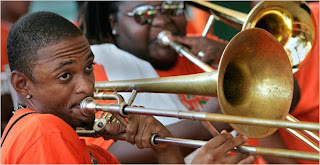 Well, I thought, brass has arrived!
And it's kind of true. At least in some places. This article is all about a summer camp program that Florida A&M University's Marching 100 has been organizing for the past 18 years, and it just about puts the last nail in the coffin of the complaint that Drumline was a totally crappy movie. (It was, if you really only care about things like plot, character development, and the nonexistence of hoary cliches.) The article itself really nails part of the reason why a program like this is a good thing for all of us:
This stuff is important partly because, as was pointed out in another recent post, teaching kids to play music often makes them better students in other areas, but also because (with all due respect*) marching band/drumline apparatus has a lot of advantages over the equipment that's usually used to create pop (as opposed to popular) music. Specifically (and incompletely): wind and percussion players don't need electricity, so they have a way easier time breaking down audience/band barriers than most rock bands do and they don't have to rely on the existence of clubs at all, if they don't want to; each band member's status as a producer of (essentially) one note/beat at a time at least points in the direction of a pretty egalitarian structure and group interdependency; the total absence of the cliches of the brooding guitar god and the charismatic lead singer.
More from the article:
I do have one caveat about the Marching 100 and highly regimented bands like that in general, though. For kids who grow up in really unstable situations, that kind of military-style discipline and order might actually be a healthy thing (for a week, at least). Personally, I grew up with more "discipline" (read: adults with crazy control issues) than I knew what to do with, and by now I'm highly suspicious of people who really like being told what to do.
* Maybe it's a non-issue, but I'd like to point out that I don't really have a problem with hip-hop or electronic music in general leading to fewer people playing horns today than 20 years ago, if in fact that's even the case. There's something pretty great about peoplewith little or no musical experience having the capacity to create and manipulate whatever sounds they want in their own bedroom and then transmit what they've made halfway around the globe, if they want to. Actually, the growth of non-professionalism in music is part of what's so great about the spike in new brass bands that I see happening these days.
 Well, I thought, brass has arrived!
And it's kind of true. At least in some places. This article is all about a summer camp program that Florida A&M University's Marching 100 has been organizing for the past 18 years, and it just about puts the last nail in the coffin of the complaint that Drumline was a totally crappy movie. (It was, if you really only care about things like plot, character development, and the nonexistence of hoary cliches.) The article itself really nails part of the reason why a program like this is a good thing for all of us:
[T]he rise of hip-hop and the computerized music programs like GarageBand has depleted the pool of young instrumentalists. In addition, many public schools have reduced or eliminated music classes to provide double periods of math and reading, which are tested annually under the education law No Child Left Behind.Hallelujah! I mean, not like any of this is a big secret, but it's nice when it's prominently acknowledged by the Journal of Record.
[Links added]
This stuff is important partly because, as was pointed out in another recent post, teaching kids to play music often makes them better students in other areas, but also because (with all due respect*) marching band/drumline apparatus has a lot of advantages over the equipment that's usually used to create pop (as opposed to popular) music. Specifically (and incompletely): wind and percussion players don't need electricity, so they have a way easier time breaking down audience/band barriers than most rock bands do and they don't have to rely on the existence of clubs at all, if they don't want to; each band member's status as a producer of (essentially) one note/beat at a time at least points in the direction of a pretty egalitarian structure and group interdependency; the total absence of the cliches of the brooding guitar god and the charismatic lead singer.
More from the article:
The Marching 100 has created a revolution in band style, radically infusing the traditional catalog of songs and formations with the sounds and dances of black popular culture. “It slides, slithers, swivels, rotates, shakes, rocks and rolls,” the band’s founding director, Prof. William P. Foster, wrote in his memoirs. “It leaps to the sky, does triple twists, and drops to earth without a flaw, without missing either a beat or a step.”Damn, I don't usually commit that many verbs in a day! Is it getting hot in here?
I do have one caveat about the Marching 100 and highly regimented bands like that in general, though. For kids who grow up in really unstable situations, that kind of military-style discipline and order might actually be a healthy thing (for a week, at least). Personally, I grew up with more "discipline" (read: adults with crazy control issues) than I knew what to do with, and by now I'm highly suspicious of people who really like being told what to do.
“They’re serious down here,” said L’Dante Brown, a 14-year-old drummer from the Virgin Islands. “When they tell you to stand still and be quiet, you can hear the mosquitoes flying.”Remember, kiddies: obedience is not always the best response to an order.
And when they tell Mr. Brown and the rest to move and make noise, and all the French horns and piccolos and saxophones and trombones sashay into action, the syncopated sound echoes across the hilly campus.
* Maybe it's a non-issue, but I'd like to point out that I don't really have a problem with hip-hop or electronic music in general leading to fewer people playing horns today than 20 years ago, if in fact that's even the case. There's something pretty great about people
New radical band in L.A.!
A message from our Streetband list, which you can join by clicking on the link on the right side of the page -
There is a new band starting up in L.A.! Fantastic!
****
The FIRST DRUMCORE rad marching band has taken place.
We now have enough people to make a start and to start
seriously practicing, thinking about performances, etc.
Our NEXT PRACTICE is this sunday July 27th.
We will be meeting at Macarthur Park.
4p.m - 6/7.
We don't have a set spot where we meet.
It's wherever we can find shade on either side of the park.
If you want to be a part of this band.
PLEASE come to the next practice.
Help us make it happen.
REMEMBER
BRING water !
BRING marching drums or a pots, pans & sticks.
A strap for your drum.
Lots of enthusiasm.
& again no experience is neccessary ! All instruction provided.
Pass it on !
And THANKS AGAIN
Linda for L.A DRUMCORE
http://www.myspace.com/ladrumcore
drum-core (at) live.com
There is a new band starting up in L.A.! Fantastic!
****
The FIRST DRUMCORE rad marching band has taken place.
We now have enough people to make a start and to start
seriously practicing, thinking about performances, etc.
Our NEXT PRACTICE is this sunday July 27th.
We will be meeting at Macarthur Park.
4p.m - 6/7.
We don't have a set spot where we meet.
It's wherever we can find shade on either side of the park.
If you want to be a part of this band.
PLEASE come to the next practice.
Help us make it happen.
REMEMBER
BRING water !
BRING marching drums or a pots, pans & sticks.
A strap for your drum.
Lots of enthusiasm.
& again no experience is neccessary ! All instruction provided.
Pass it on !
And THANKS AGAIN
Linda for L.A DRUMCORE
http://www.myspace.com/ladrumcore
drum-core (at) live.com
21 July 2008
Second Line, Home and Away

Here's a couple of pretty good articles about two of the really great New Orleans-based brass bands today: Rebirth and the Hot 8. Rebirth, obviously, are kind of the pioneering superheroes of the modern second line bands. They started doing what they do more than 25 years ago when playing in a brass band just wasn't all that cool. If that has changed since then, it's largely because of them. Now snare player Derick Tabb, along with Trombone Shorty and several other brass band folks from the area, are starting up a program to teach elementary school kids how to play instruments.
It will draw students mainly from five Recovery School District elementary schools, which don't have marching band programs, and put them in summer music classes. During the 2008-09 school year, the students will attend after-school classes for three hours.The Hot 8 always seemed like a kind of underdog in a city of underdogs. Until recently, they never seemed to get the recognition that they deserved (and maybe they still don't, tho there seem to be a lot of articles about them cropping up lately). And they've stuck it out through a nasty pile of hardship over the past few years, even by the rough standards of their home town
...
"I lost a little brother to gunfire, and Derrick has lost cousins," said Corey Henry, Rebirth's trombone player and a product of a Treme elementary school marching band.
Andrews said, "If we get them at the age Derrick is targeting, they'll also be getting a similar education as they would get at (New Orleans Center for Creative Arts), only they'll be starting younger."
...
Until the program finds more money, the teachers will volunteer their time, said Lawrence Rawlins, one of the instructors working with Tabb. Teaching students music can lead to them learning far more, [Pam] Breaux [assistant secretary of Louisiana's Office of Cultural Development] said.
"Take it a step at a time. You get a better student, you get better test scores," she said. "You get better test scores, you get more of an opportunity for higher education. You get better educated workers, you get a better work force for the state."
[T]he Hot 8 experienced its own private, yet sadly typical, tragedy in December 2006. Drummer Dinerral Shavers died, age 25, shot in the back of the head while driving his car.Anyways, if you're not familiar with the background of the modern second-line bands, these pieces might give you a couple of hints about where they're coming from. And if you already know, then here's what two of the best are up to at the moment.
...
[I]t's very hard to make a living on the local scene; venues aren't paying enough. "You want to work, because you want to play for your home crowd," he says. "We still do a lot of second-line parades and private parties. It just makes you want to do your own thing, free performances for the people."
This matters, of course, because New Orleans brass-band music is organically of its city and has always thrived on interplay outside, on the street, in the parades where folks perpetuate old dances and invent new ones. Separate the sound from the street and you stunt it, take away the point.
...
"We need to keep the music going," Pete says. "It don't make no sense to break up. I wanted to leave, I didn't want to play, I was tired. But I made a commitment to the other band members - and to the forefathers on whose shoulders we step."
20 July 2008


03 July 2008
Thisnthat

I promise to have a big ol' multi-record review coming up soon. But in the meantime, I would like to point out (for anyone in the greater-Seattle metropolitan area) that the Weapons of Marching Destruction (spawn of INB, grand-spawn of ¡Tchkung!) are looking for members. To wit:
Radical Marching Band Seeks Drummers and Brass Players.
Weapons of Marching Destruction, Seattle's loudest radical drumline is looking for collaborators. We need confident, competent drummers and brass players who are not afraid to play with some flair. Previous experience on your instrument required. Marching experience encouraged. BenjaminBearMusic@gmail.com
Instrument: Drums/percussion and Brass=======
Beyond that, for your viewing pleasure, I give you some pretty well shot footage of Extra Action at a Halloween party a few years back. I like to amuse myself by trying to identify band members' faces (I see Josh and Wiley and Simon and Ena ... it's like a frickn episode of Romper Room).
26 June 2008
Atlanta Sedition Orchestra in the Atlanta Journal-Constitutional!

Last year, Becca and Phil from the Rude Mechanical Orchestra departed from our fine island and headed south, like little marching-band Johnny Appleseeds, and started a new band. Now Atlanta can boast not only the Seed and Feed Marching Abominable, but also the svelte and rowdy Atlanta Sedition Orchestra. Along the way, and much to my delight, Becca picked up the sousaphone, and not just any old sousa—it's a double-belled badass sousaphone decked out in flames. B&P are heading back to New York, and the ASO just received a very nice treatment in the Atlanta Journal Constitutional -
Atlanta Sedition Orchestra marching band mixes politics, punk and parade
By JAMIE GUMBRECHT
The Atlanta Journal-Constitution
Published on: 06/26/08
It started as a parking lot party, more friends than strangers, all drinking beer and enjoying a cool night near the end of May. They were celebrating the opening of the community arts center WonderRoot, touring its fancy new digs and waiting in the breeze for the bands in the basement to turn on the amps.
It didn't take long for the drags of an old familiar tune to blow through the parking lot off Memorial Drive, no amplifier necessary. After that first brass bellow was a tap on a drum, the shuffle of movement, then a full marching band in black-and-purple stripes, ribbons and tassels. It wailed "Saint James Infirmary Blues" and poured from the basement led by a double-belled sousaphone painted like a fire-breathing dragon. Euphonium, trombone, alto sax, tenor sax, bass and snare drums, cymbals, tambourine, a whistle.
Conversations stopped. Rookie audience members raised their eyebrows; regulars at protests and benefits smiled. It took a few songs before they were officially introduced.
But the drums were labeled: ASO.
"Some people were just shocked," says Chris Appleton, a WonderRoot founder. "A marching band?"
Like every gig the Atlanta Sedition Orchestra plays, it wasn't just a party. It was a parade.
The band started in late 2007, rehearsing in living rooms and borrowed spaces with half a dozen musicians. Since then, its membership has grown to 30 or so, and its list of gigs includes a Cabbagetown benefit, feminist talk show on WRFG-FM (89.3), bicycle auction and a fund-raiser for Grannies for Peace.
With traditions borrowed from high school football fields, New Orleans jazz funerals and protests marches, it attracts musicians without a venue and activists without an organization. The sound is unpolished, but soulful and spirited. The band is political like Infernal Noise Brigade, a well-known, now-defunct Seattle marching band that formed to protest 1999 World Trade Organization meetings. But it's all ages, spontaneous, community-oriented, fun and local like the Seed & Feed Marching Abominable from Inman Park.
No musical experience necessary, purple-and-black "uniforms" requested, passion required.
"We all share a kind of joy in taking public spaces," says Rebecca Miriam, 25, a sousaphone player who helped to start the group after she moved to Atlanta in August 2007. "People come to the band because they're on the same page and want to use their talents."
In radical bands and dance teams across the country, those talents range from superior musicianship and composing skills to willingness to pick up a cowbell and make it rock. New York City has its Rude Mechanical Orchestra; Somerville, Mass., the Second Line Social Aid & Pleasure Society Brass Band; Greensboro, N.C., the Caka!ak Thunder; San Francisco Bay area, the Brass Liberation Orchestra.
These motley bands of amateur aficionados and musical newcomers formed around the country for the last decade, sometimes with other groups as inspiration, but just as often without it, says Kevin Leppmann, an organizer for HONK! Festival, an annual gathering of street bands to be held in October in Massachusetts. The surest way to get people behind a cause, he says, is to tell them to bring a tambourine or a horn.
"The whole idea is to have fun reclaiming our public spaces, reclaiming our connections to each other," says Leppmann, a trombone player. "We were surprised as anyone to find that [bands] keeps emerging and producing all over. Something about the present sociopolitical situation leads people to pick up and instrument and make some noise."
Miriam organized Rude Mechanical Orchestra's dance team before she moved to Reynoldstown with her partner, Phil Andrews, 29, a trombone player. His story is typical of the Sedition Orchestra: He loved playing music during high school in Pennsylvania, but didn't like the structure, so he gave up his horn to play in a punk band. When he found the marching band with "a punk rock sensibility" as an adult, his mom mailed his trombone.
The Sedition Orchestra recruits through word-of-mouth and Craigslist. Their ad is simple: "We perform at marches and fundraisers around town in support of local causes ... If you've just started playing, you play every day, or haven't picked up the thing in years, we invite you to come play with us."
Joining gives people a chance to say with a straight face that they play the washboard or the megaphone for the ASO, if not the Atlanta Symphony Orchestra.
The going rate for a performance: free.
Whichever members are available make up the band that day. They play in whatever space is available. That usually means playing as part of the crowd, like in the WonderRoot parking lot, where the band tangled itself in the bikers, drinkers and artists who'd moved outside. The band paused sometimes for a tune, took dramatic sideways steps forward, laid down on the ground and played in the air. Then they'd spring up and dart to another side of their crowded, asphalt stage.
"It's challenging people to move around," says Appleton, the WonderRoot founder. "As soon as people got comfortable and got in their little spot to watch the band, they would move. That was a nice parallel with [Sedition Orchestra's] purpose."
That purpose varies member to member.
• Alessandro Chapman, 20, who borrowed a pair of cymbals so he could be involved: He wants to see the end of capitalism in the United States, and says the band can be a part of it.
• Hiron Roy, 22, a Georgia Tech student and alto sax player: He wants a group that keeps him playing and performing.
• Amy Plasman, 28, a euphonium player of eight months: She wants a different level of political involvement. "I don't usually just go to a march or a protest, but I will go with the band," she says.
Principles and purpose aside, they all agree with the good, old-fashioned idea that everything, from a sporting event to a protest, is more exciting when a marching band shows up.
The repertoire is a bit of a surprise too, ranging from "We Shall Overcome" to Salt-n-Pepa's "Push it."
Miriam and Andrews brought the idea for a band to Atlanta, but they moved back to New York this month. They'll tour with Rude Mechanical Orchestra this summer. Sedition Orchestra members pout about how much the organizers will be missed, but say they're not nervous about what happens next.
They make decisions together, sticking to what might be rules, if this were a rule-making kind of organization: Everyone in the band is an individual, everyone is there because he or she supports the cause (whatever it is that day) and everyone in the band matters.
They democratized quickly, finding others to lead rehearsals and create new pieces for the band. They want more members, a fuller sound, to see some faces from the crowd at rehearsals, a color guard to fly the purple and black.
There's no shortage of rallies and fund-raisers that could use a boost. Their services are in demand.
It's a parade. They just try to keep moving.
Subscribe to:
Posts (Atom)